Tactic code eg5o@i?koeyr brings together Raya, a three-man defense, a Bonmatí–Stanway midfield partnership, and a front line built around Putellas, Di Natale and Dembélé. The key question is how these players work together—and where this lineup leaves itself exposed.
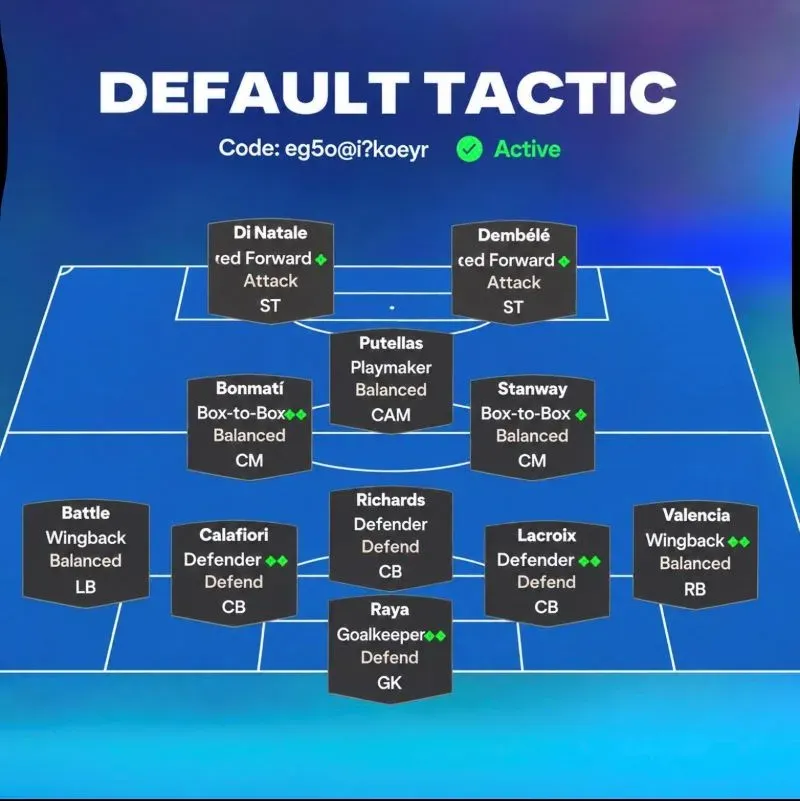
The Starting XI: How This 5-2-1-2 Is Built
- GK: Raya — Goalkeeper / Defend
- CB: Calafiori, Richards, Lacroix — Defender / Defend
- WB: Battle, Valencia — Wingback / Balanced
- CM: Bonmatí, Stanway — Box-to-Box / Balanced
- CAM: Putellas — Playmaker / Balanced
- ST: Di Natale, Dembélé — Striker / Attack
Raya and the Back Three: The Defensive Foundation
Raya plays as a Goalkeeper / Defend behind Calafiori, Richards and Lacroix, who form a three-man defensive line. Calafiori covers the left side, while Richards and Lacroix occupy the central and right channels. Their Defender / Defend roles prioritize holding the defensive line, while Battle and Valencia provide width higher up the pitch.
Battle and Valencia: The Two Routes to Width
Battle and Valencia are the team's primary sources of width, both operating on Balanced instructions. They can join attacks to stretch the opposition and supply Bonmatí, Stanway and Putellas, but must track back after losing possession.When both wingbacks advance, the back three may have to defend a wider area, making it harder to protect the channels and the space in front of goal. Use one at a time for width to keep shape compact.
Bonmatí and Stanway: The Midfield Partnership
Bonmatí gives this midfield a technical passing option, while Stanway adds another box-to-box presence alongside her. Their Balanced instructions allow both to contribute in attack and defense, but neither provides the fixed protection of a dedicated CDM. If both move forward during the same possession, the space in front of the back three can become vulnerable.
Putellas Behind Di Natale and Dembélé
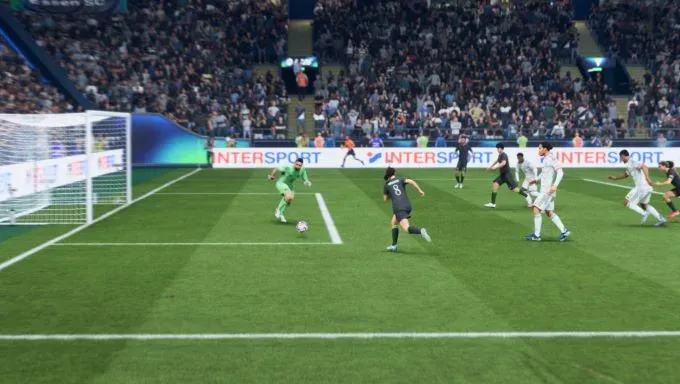
Putellas acts as the key link between midfield and attack. She collects from Bonmatí and Stanway, then unlocks the front line with sharp passes.Di Natale and Dembélé give Putellas two attacking options, but they should not be treated as identical strikers. Use Di Natale for runs into scoring positions and let Dembélé threaten space behind the defense. This gives Putellas more than one type of forward pass instead of relying on the same central combination every time.If Putellas is tightly marked, the supply to both strikers can become limited. In that situation, Battle and Valencia become important alternative outlets for progressing the ball.
The Main Weaknesses and How to Adjust
The main weakness is the lack of a dedicated CDM. Defensive stability depends on how quickly Bonmatí and Stanway recover their positions after possession is lost.
- Against deep blocks: Use one wingback for width, keep the other conservative. Work through Putellas and Bonmatí rather than forcing central runs.
- Against pacey wide attackers: Hold wingback overlaps, use Stanway or Bonmatí to drop and guard central lanes.
- Protecting a late lead: Limit B2B surges; keep one midfielder back to cover the space before the three centre backs.
Who Should Use This Setup?
This lineup suits players who prefer patient possession play and can manually manage counterattack risks. It rewards timed wingback runs and quick combinations through Bonmatí, Stanway and Putellas.It is less ideal for players who want automatic defensive security or a dedicated CDM shield.
Wrap Up
This 5-2-1-2 is built around the balance between its midfield and attacking partnerships. Bonmatí and Stanway must cover the space left by the advancing wingbacks, while Putellas needs to keep Di Natale and Dembélé involved. It is a setup worth testing if you enjoy possession-based attacks and are comfortable managing defensive transitions manually.