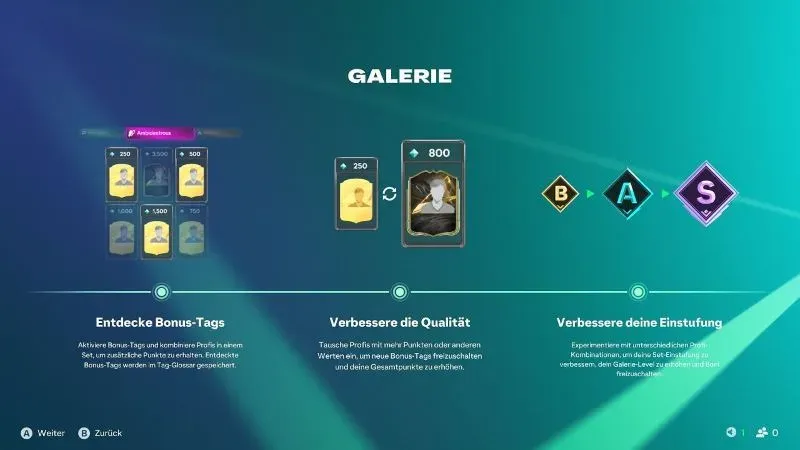
You’re at A-Grade. The Set looks close enough. One more push and you’ll see that S, right?
Maybe. But “close” in Gallery score is where coins disappear unnecessarily. A-to-S is not a linear step—the final jump often demands a sharper score threshold, and the extra Token reward does not always scale with the cost. This guide is about one decision: should you pay for S, or bank the A and move on?

Step 1: Focus on the Additional Reward, Not the Total
Gallery rewards are cumulative, so reaching S includes the rewards from lower grades. For an upgrade decision, however, only the additional Tokens matter.
Extra Tokens = Cumulative reward at the target grade − Cumulative reward at your current grade.
For example, if your current grade has paid 13 Tokens and S brings the cumulative reward to 28, the upgrade adds 15 Tokens. Use this difference—not the full 28—to evaluate the extra investment. If the jump only adds a handful of Tokens, that is your first warning sign: the score gap is probably far larger than the reward.
Step 2: Calculate What the Upgrade Really Costs
The coins you spend are not the coins you lose. Upgrade cost is the net number.
Net Upgrade Cost = Purchase Cost + Opportunity Cost − Resale Proceeds After Tax.
- Purchase Cost: Cards and fodder bought specifically for the push.
- Resale Proceeds After Tax: What you actually receive after the 5% transfer tax.
- Opportunity Cost: The value of the alternative use you give up by consuming existing or untradeable cards, such as using them in another SBC.
A card bought for 2,000 Coins and resold for 2,000 Coins still costs you 100 Coins in transfer tax. Stack twenty of those and the “cheap” upgrade quietly gets more expensive. First Owner cards may reduce the number of market purchases needed—but only when you already own eligible items that contribute meaningful score. Treat that as a cost-saving advantage, not a reason to buy more cards.
Step 3: Calculate Your Cost per Additional Token
This is the number that decides the upgrade.
Cost per Extra Token = Net Upgrade Cost ÷ Extra Tokens.
Illustrative example, not a live Set: your current grade has paid 13 Tokens. S would bring the cumulative total to 28, adding 15 Tokens. If the net upgrade cost is 6,000 Coins, each additional Token costs 400 Coins. If the same upgrade actually costs 15,000 Coins net, that number jumps to 1,000 Coins per Token.
Set a personal spending ceiling based on the Gallery rewards you actually want and the coin cost you would be willing to accept to obtain them. If the calculated cost exceeds that ceiling, the upgrade may not be worthwhile.
Step 4: Three Situations Where You Should Stop
1. The required cards are overpriced. If the remaining score needs premium special cards at inflated market prices, the S push is an upgrade funded almost entirely by market purchases. Wait for prices to settle or skip it.
2. The cards have better uses elsewhere. If using your existing cards means giving up a valuable SBC opportunity, include that lost value in your calculation. A cheaper upgrade on paper may not be the best use of your club resources.
3. The market is too volatile to judge. If the required cards are moving sharply in price, your estimated resale proceeds may no longer be reliable. Wait for prices to stabilize, then recalculate before committing coins.
Bottom Line
A-Grade can be the smarter stopping point. Before you chase S, count only the extra Tokens, price the net upgrade cost after tax and consumed cards, then divide. If the cost per new Token stays below your ceiling, upgrade. If it exceeds your limit, bank the A and spend those coins where the return is better. The goal isn’t the highest letter grade—it’s the best Token value per coin.