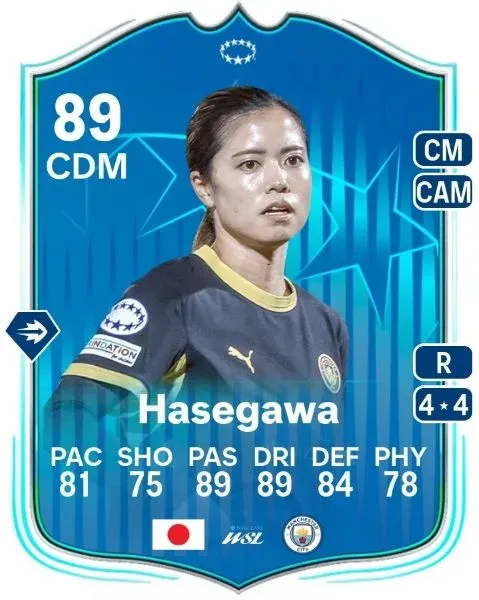
At 156cm and 68 strength, RTTK Hasegawa doesn't look like the answer to a midfield problem. In a game where stronger players can still punish you in direct physical battles, she reads as a liability with good passing numbers.
The interesting question isn't whether she can win those battles. It's whether a midfielder with her profile can solve a different problem entirely: what happens after the ball is won, when the press is already arriving.
The First Touch Is the Whole Card
Many defensive midfielders can win the ball back, but not all of them can turn that recovery into clean possession when the opponent presses immediately. The touch takes them somewhere they don't want to go, and the build-up becomes a scramble.
Hasegawa is built for that exact moment. Her 90 ball control and 91 balance allow her to receive with her back to goal, adjust away from the pressing angle, and face forward before the defender has fully committed. The exit doesn't require a skill move. It requires one directional adjustment and a short pass. The value isn't flair—it's the speed with which a difficult reception becomes a playable one.
Press Proven supports this without making her stronger. It keeps close control at jog speed and helps her shield the ball more effectively from stronger opponents, reducing how often she has to absorb contact at all rather than trying to win it. Tiki Taka adds a clean first-time exit when the press arrives in pairs, and Pinged Pass+ moves the ball to the next line before the second defender can close.
Hasegawa vs Stanway: Two Ways to Solve Midfield
Georgia Stanway's gold card is the natural comparison, and the gap is about approach, not quality.
| Game moment | Hasegawa (RTTK 89) | Stanway (gold 86) |
| Receiving under pressure | Adjusts out of pressure more easily | Uses physical presence to protect possession |
| Ball retention | Close control and balance | Strength and shielding |
| Defensive action | Anticipates passing lanes | More comfortable in direct challenges |
Hasegawa defends by being early. Her 89 interceptions and 90 defensive awareness are genuinely good numbers for a midfielder who isn't asked to dominate duels. But if the sequence becomes a shoulder-to-shoulder battle or a back-post header, she loses it. Stanway, at 164cm and 72 strength, has a slight physical edge that makes her more comfortable in those moments. Hasegawa's defensive value comes from making sure the ball doesn't reach the duel in the first place.
The Right Partner (and the Right Role)
RTTK Hasegawa should not be the only holding midfielder against an opponent who overloads the center. Without a physical partner, she gets bypassed in exactly the sequences her profile cannot win.
Her best setup is alongside a more physical CDM on Holding/Defend. Hasegawa handles the first pass out of defense and decides where the ball goes. Her partner absorbs contact, covers the channels, and contests second balls.
Her CDM role set gives her genuine flexibility. Holding++ comes on the card by default. Deep-Lying Playmaker++ is available through the CDM Roles++ evolution, not as a default role on the RTTK card. For a build-up-focused pivot, Deep-Lying Playmaker++ is the better fit once added, because it leans into her distribution and positioning. Without that evolution, base Deep-Lying Playmaker still functions, but Holding++ is the stronger default if you want her screening rather than starting attacks.
A Box-to-Box partner can work in a 4-4-2, but only if that player has the recovery speed to cover when Hasegawa is bypassed. Asking her to defend a large open space alone is asking her to be the midfielder she isn't.
When She Becomes a Problem
The limits are straightforward:
- When the opponent skips midfield with long balls and forces her into aerial duels.
- When protecting a lead requires winning physical battles in the box.
- When the formation leaves her as the last line before the center-backs.
Her 68 strength and 156cm frame are not hidden in those moments. They are the reason the sequence is lost.
Is She Worth It?
RTTK Hasegawa makes the most sense for players whose midfield struggles against aggressive pressing. If the current CDM can win the ball but turns into a scramble machine when pressed, she offers a different kind of upgrade: not more tackles, but cleaner exits and a calmer first pass.
If physical dominance is the priority—bodying people, winning headers, holding the line without help—she isn't the answer, and press resistance won't change that. Hasegawa is a specialist. In the right pivot, with the right partner, that specialty is worth building around.