You just lost to a guy who never pressed sprint. No skill moves. No 40-yard lasers. He kept the ball, one touch at a time, until your block opened a crack—and then he stabbed it.
Pinged Pass+ and Incisive Pass+ still break lines. But EA’s October Developer Notes show something more interesting: players are completing a higher percentage of passes while attempting slightly fewer, and manual interceptions are ticking up. EA reads that as players choosing their passes more carefully. The takeaway: patient circulation and better timing can matter just as much as raw speed of delivery.
This isn’t another “what is Tiki-Taka” tutorial. It’s a decision guide: when short passing beats power, who actually has the traits, and how to set up a midfield without copying the same generic template.
Tiki Taka vs Pinged Pass: Different Tools, Different Jobs
Tiki Taka improves the accuracy of difficult first-time ground passes and short-distance combinations. Tiki Taka+ takes that accuracy even further—but the base version already makes rushed one-touch passing more reliable in traffic. Pinged Pass does something different. In FC 27, it focuses on the pass itself: it increases ground-pass speed without affecting the receiver’s trapping difficulty.
They are not substitutes.
| Match situation | Trait that actually helps | Why |
|---|---|---|
| Tight midfield, one-touch escapes | Tiki Taka | Higher accuracy on difficult first-time ground passes |
| Faster ground switches across midfield | Pinged Pass | Ball travels faster along the ground, trapping difficulty unchanged |
| Receiving under pressure, keeping control | Press Proven / First Touch | Press Proven aids shielding at jog speed; First Touch reduces trapping error |
| Final ball into a runner | Incisive Pass | Sharper through-ball quality |
Tiki Taka is not “the better passing trait.” It’s the connective trait. You still need a finisher. You just can’t only have the knife.
Player Picks: What Their Cards Actually Offer
Most guides mash PlayStyle+ and base PlayStyles together. Here’s how the relevant cards differ.
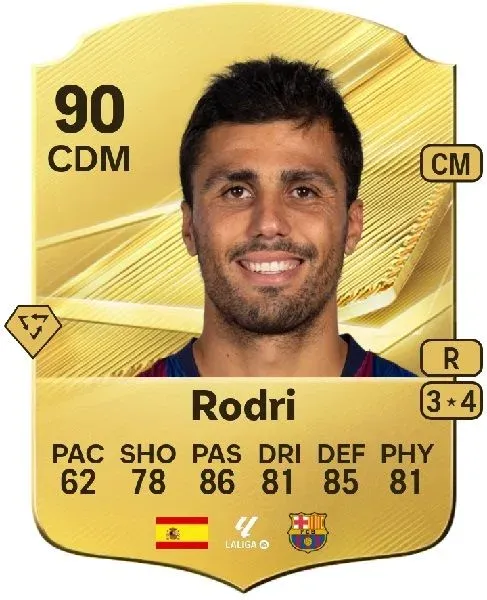
Rodri: The Defensive Tiki-Taka Anchor
Rodri’s 90 Gold card has Tiki Taka+, confirmed on EA’s official Tiki Taka+ player ratings page—he is listed among the top-rated holders alongside João Neves and Fabián Ruiz. He’s slow. He doesn’t care. His job is to receive from the center-backs, kill the first press with a one-touch ground pass, and recycle. If you want a single pivot who starts possession and shields the back line, Rodri is the template.
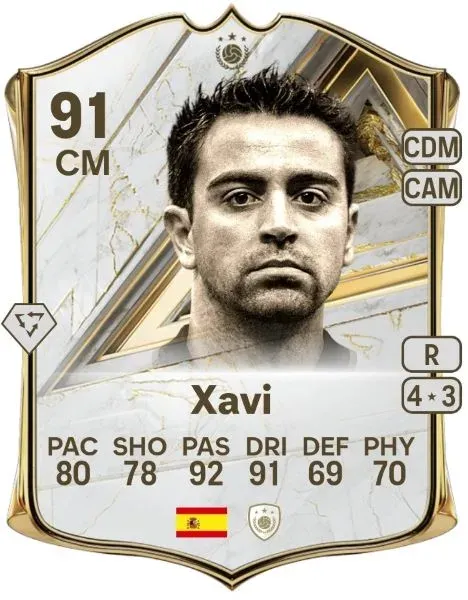
Xavi Base Icon: The First-Time Metronome
Xavi’s 91 Base Icon carries Tiki Taka+ alongside Incisive Pass, Pinged Pass, and Long Ball Pass. This data comes from third-party card databases (FCData, FUTWIZ) rather than EA’s Gold ratings page, so treat it as card-database information. He is one of the clearest examples of a pure first-time passing midfielder. Pair him with a physical ball-winner and let him dictate tempo. He will not win a footrace. He will not need to.
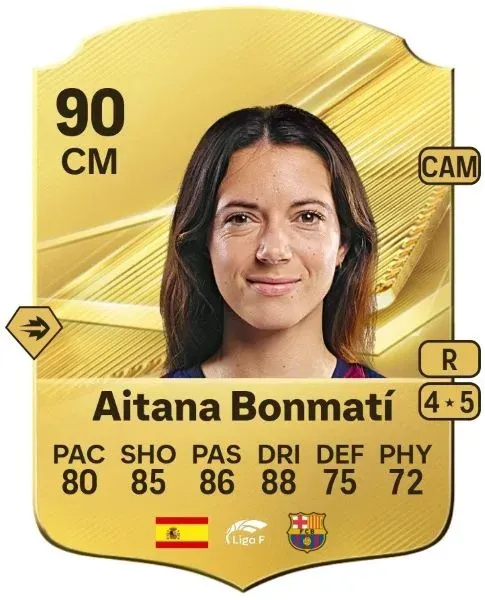
Aitana and Pedri: The Hybrid Connectors
Aitana Bonmatí’s 90 Gold card has base Tiki Taka—not Tiki-Taka+—alongside Pinged Pass+ and Incisive Pass. Pedri’s 90 Gold card also has base Tiki Taka, Pinged Pass+, and Incisive Pass, alongside Long Ball Pass. Neither is a pure metronome. They are carriers who can combine and still deliver the final ball.
The point: don’t force Tiki-Taka+ onto every midfielder. One metronome is enough. The other slots bring Incisive Pass, physicality, or ball-carrying. A midfielder with elite short passing and composure can outperform a Tiki-Taka+ holder with weak all-round stats.
A Simple Three-Role Midfield Setup
| Role | Job | Priority |
|---|---|---|
| CDM | Receive from CBs, recycle, shield | Tiki Taka, Def. Awareness, Short Passing |
| CM (connector) | Link midfield to attack | Tiki Taka or strong Short Passing, Incisive Pass, Composure |
| B2B CM | Attack the space short passing creates | Pace, Stamina, Strength, Ball Control |
One metronome at the base. One connector who can combine and play the final ball—not necessarily a second Tiki-Taka holder. One runner who punishes the space.
Passing Controls: Know Your Through Balls
This is where a lot of guides go sideways. L1 + Triangle is Lobbed Through Pass—a lofted ball over the top, not a low through ball. If you want a ball along the ground, that’s Through Pass (Triangle / Y) or a precision variant.
- Through Pass (Triangle / Y): standard runner’s ball into open grass.
- Lobbed Through Pass (L1 + Triangle / LB + Y): defense compressed high, runner attacking the last line from deep.
- Driven Through Pass (L1 + R1 + Triangle / LB + RB + Y): speed through a low gap.
- Precision variants: check your in-game Classic Controls menu—sources differ on the exact combination for Precision Through Pass, so don’t assume one universal button map.
FC 27 places more emphasis on directional input for through passes. Choosing the correct angle matters as much as the pass type.
Three Scenarios Where Short Passing Wins
Opponent presses high with numbers. Do not turn your CDM into the press. Bounce it: CB → CDM → CM → wide CM. Three one-touch passes, and the press is behind the ball. Tiki Taka is doing the work.
Low block, no forward lane. Short passes move the block sideways. Wait for the far CM to drift into the half-space, then trigger the Incisive Pass. The short passing creates the timing; the through ball finishes it.
Opponent midfield steps up. Their CM leaves the pocket to close you down. Quick short combination to bait the step, then a precision through ball into the space they vacated.
The Verdict
Tiki Taka is not “the best passing PlayStyle.” It is the stabilizer.
Choose Tiki Taka when your midfield needs reliable short combinations under pressure. Choose Pinged Pass when moving the ball quickly across the pitch matters more. The strongest midfield is not built around one trait—it’s built around knowing when to use each one, and having the players whose PlayStyles actually match the job.