In Champs, every defensive switch is a trade-off. Step out too early and you open the space behind. Hold back too long and the attacker has time to turn. The game is not asking whether you know how to jockey. It is asking which threat you are willing to live with.
These five decisions are the ones that separate defenders who close games from the ones who concede in the 88th.
Decision 1: Switch to the CB when the run behind is already live
Tracking back with a midfielder keeps your back line intact. The harder call is when to let go of the CM and grab the CB.
Do not switch on the first touch alone. Read the receiver’s body shape and the run developing behind him. If the striker receives facing your goal, with a runner attacking the channel beside your CB, switch as the pass arrives. The CB needs that half-second to drop and cover the run.
If the striker receives with his back to goal and no runner is threatening the line, stay on the CM. Abandoning the midfield screen for a stationary receiver opens the return pass into the CAM.
Decision 2: Narrow the fullback while the central threat is active—then release him
Tucking fullbacks inside against narrow attacks closes the half-space. The mistake is treating that as a permanent setting.
Narrow the fullback while the opponent is actively attacking the center. The moment the ball is recycled back to the touchline and the flank becomes the more immediate danger, manually push him back out. If you leave him inside through the switch, the half-space you closed becomes an open wing on the other side.
Fullback AI can drop too deep and unintentionally keep attackers onside. That is exactly why the manual adjustment matters: the AI’s default behavior is not something you should build your defense around. Read the developing attack and move the fullback yourself when the wide threat becomes the immediate problem.
Decision 3: Read the CAM-to-ST connection before stepping out
When the opponent’s CAM drops deep, do not follow with your CB. Use the CDM to screen the lane, and watch the striker’s movement off the ball.
If the striker pulls away toward the line, the pass over the top is live. Keep the CDM in the lane but do not step him out. Let the CB drop one step deeper instead of jumping the CAM.
If the striker checks toward the ball, the ground pass into feet is the threat. Now you can step the CDM into the reception, because the run behind has not started yet.
The decision is not “press the CAM.” The decision is which pass you are willing to concede.
Decision 4: Defend the cutback runner when the fullback already has the carrier
When the opponent reaches the byline, the automatic move is to send everyone at the ball. That is the trap. A cutback to a free runner near the penalty spot can be more dangerous than a shot from a tight angle on the byline.
The decision only applies when your fullback is already containing the carrier wide. If the fullback has the ball side covered, control the center-back who can step into the cutback lane. Let the carrier go wide. You are accepting the possibility of a shot from a tight angle to protect the more dangerous central pass.
If the fullback has not engaged the carrier, do not abandon the flank to grab the CB. Fix the containment first, then protect the cutback.
The moment the carrier stops and turns back instead of crossing, release the CB and re-engage. Chase too early and you vacate the exact zone the cutback is designed to hit.
Decision 5: Hold shape late instead of sending the CB to chase
Protecting a one-goal lead in the last fifteen minutes, the temptation is to press higher and “kill the game.” That is how leads disappear.
Team Press cannot provide automatic pressure inside your own defensive third in FC 27, so you have to generate pressure manually if you want it. But sending a center-back out of the line to chase a ball in midfield opens the space behind him for the through ball.
The late-game decision is to hold defensive depth and let the opponent pass sideways. Protect the central lane. Press only when the ball goes into a wide area with the receiver facing his own goal—that is the moment to squeeze. Every other possession, hold shape and make them create through a low block.
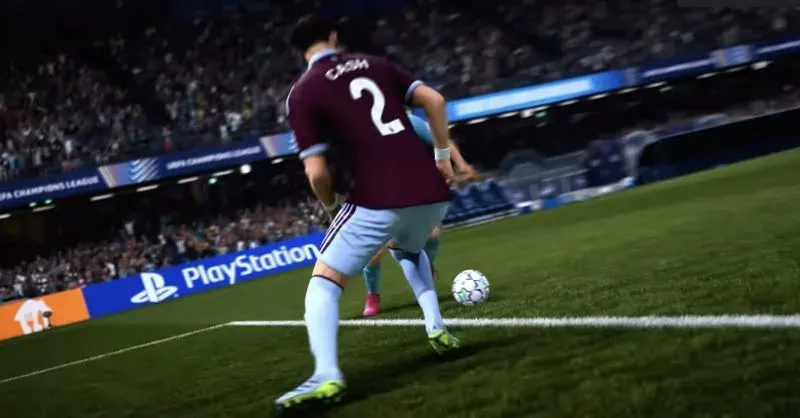
The Champs filter
You do not need five new controls. You need five cleaner sacrifices: which pass you allow, which runner you ignore, and which space you refuse to open.