You know that gut punch moment. You win the ball back, and instantly the opponent’s attackers flood your defensive third. Every forward lane gets closed off. Most players rush a desperate long ball and hand over a counter.
This guide is built around one core idea: Stop trying to pass through the press. Learn how to move the press before playing through it. This is not a repeat of our FC 27 first touch guide, which covers individual receiving technique. Here we focus entirely on team sequencing and passing decisions to unlock trapped possession.
The Core Idea of Beating High Press in FC 27
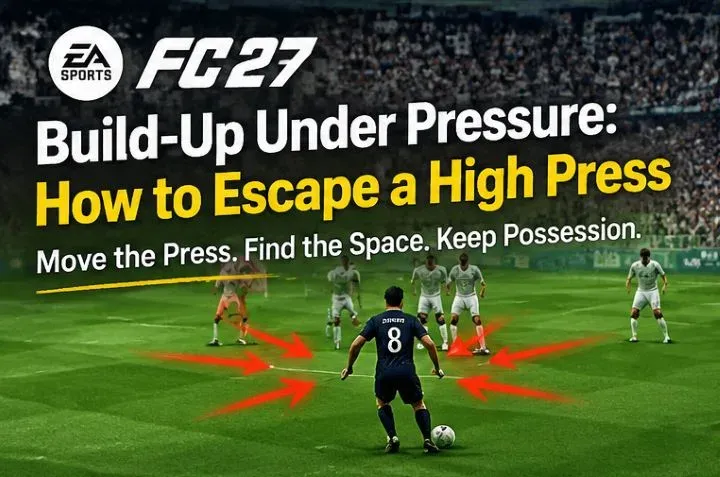
A high press works by outnumbering you near the ball. The closest attacker forces a rushed choice, while cover players block forward outlets. Your goal is to drag defenders sideways, stretch their compact shape, and create a passing lane before they lock everything down.
Every choice you make should either draw pressure to one side or reset the shape. You don’t need perfect skill moves. You need readable, repeatable passing patterns.
Identify the Press Before Choosing Your Exit
Scan three details before touching the ball: how many attackers are committing, which lanes they are blocking, and which flank looks understaffed.
If only two players close you down, you can often work through them. If three or four flood your backline, forcing forward passes rarely works. Look for a safe reset instead. Some gaps may look open, but a hidden covering defender can intercept instantly.
Use Supporting Runs to Open Passing Angles
Support runners are there to create triangles, not just stand waiting for a pass. A midfielder checking short or a fullback tucking inward pulls one presser toward the ball, which can open a new angle elsewhere.
A sideways or slightly deep check is usually better than a straight forward sprint. For example, a CDM moving a few yards toward the ball can give your center back a safer outlet while pulling the opponent's CAM away from the central lane. Forward runs can walk straight into a waiting defender. Always keep one fallback option available, so you don’t get stranded if the press tightens back up.
Third-Man Runs: Move the Ball Beyond the First Presser
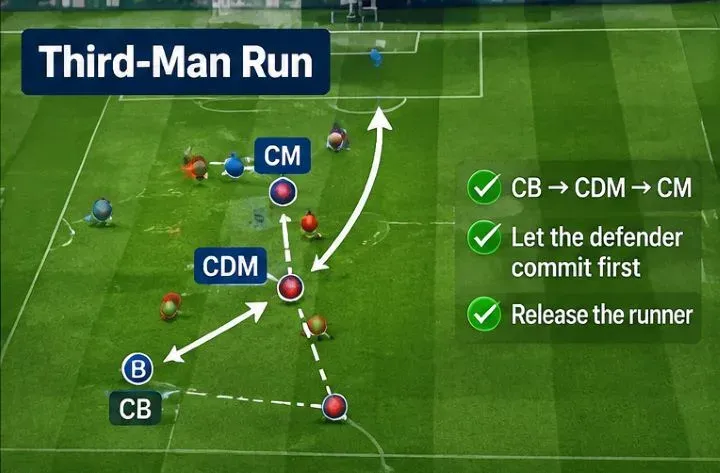
Third-man combinations are the sharpest tool here, and timing is everything. Use this reliable sequence: CB → CDM → CM.
Your center back feeds the CDM. As the opponent’s CAM steps toward the ball, your CM moves into the space behind or beside them. The CDM does not need to turn or dribble; they simply release the ball to the third man if the passing lane is open.
This fails if the third runner moves too early. The runner only gets usable space once the defender commits to the first receiver.
Back Passes: Reset the Press Without Losing Control
Back passes are not a sign you’re stuck. They shift the burden back to the pressing side. When every forward route is covered, a safe back pass can give you a new angle and force the opponent to adjust their pressing positions. If they continue pressing, use the extra passing option to move the ball away from the crowded side rather than forcing another forward pass.
Do not spam blind backward passes. Only recycle to a teammate with clear space around them. After resetting, check whether the opposite flank is still open. If the opponent has shifted across, use the spare passing option to recycle again rather than forcing the switch.
Switch Play to Exploit the Weak Side
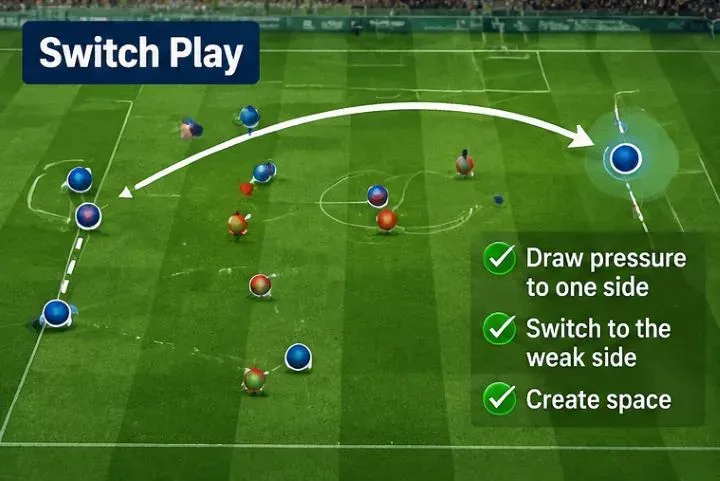
Pressing teams usually commit more players to one side of the pitch. That busy side is the strong side; the far flank is the weak side.
Draw pressure onto one side with short triangles first. Once defenders shift over, hit a driven ground switch if the lane and distance are manageable. For longer cross-field moves, use a lofted pass when you have enough time and space. Judge the pass by defender positioning, not raw distance.
A Real Build-Up Sequence: Escape Pressure From One Side
Let’s walk through a realistic in-game chain. An opponent’s striker closes your left center back, while their CAM blocks your CDM’s central receiving lane.
Your left fullback checks inward and slightly deep to offer an angle. Your CB plays short to this fullback. If the opponent's winger follows the fullback inward, the space outside them may become available. If they hold their position instead, keep the ball and use the spare center back rather than forcing the switch. Now the press has tilted left. You pass back to your spare center back, then trigger a switch to your right side.
Your right-sided receiver now faces forward with more room. From there, you choose: drive forward, combine again, or recycle once more. Every pass in this sequence exists to pull defenders, not just advance the ball.
Common High-Press Escape Mistakes
- Forcing forward passes into crowded lanes, handing the presser the turnover they want
- Sending every available runner forward at once, with no safety outlet
- Holding the ball too long while defenders continue closing angles
- Relying only on long balls over the top against a high line
- Repeating one pattern nonstop, letting opponents shadow your runners
Practice Your Build-Up Decisions
Use Kick Off against an AI opponent and practice building out from your defensive third.
Start from your backline and work through the four choices: short support layoff, third-man release, reset pass, and weak-side switch. After every turnover, pause and identify which passing lane was blocked and what alternative was available.
Wrap Up
Escaping a high press is about controlling where the opponent commits players, not simply finding the fastest forward pass. Draw pressure toward one side, recognize the space it creates, and move the ball before the next defender closes in. Once you stop treating every pass as a chance to move forward, building out under pressure becomes much easier to manage.