When your squad has a weak spot, you have two obvious paths: evolve a player you already own, or spend coins on a ready-made card from the Transfer Market. Many players default to Evolutions because they enjoy building their own club stars, but that feeling does not always line up with good resource management.
This is not a guide listing which Evolutions are the best. Its job is to answer one sharper question: given the same budget and squad goal, should you evolve, buy, or simply wait for a better option?
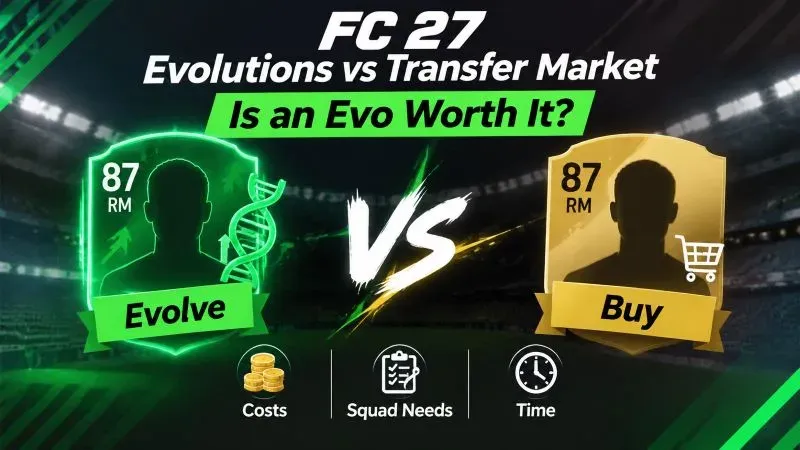
Compare the Finished Evo With a Market Alternative
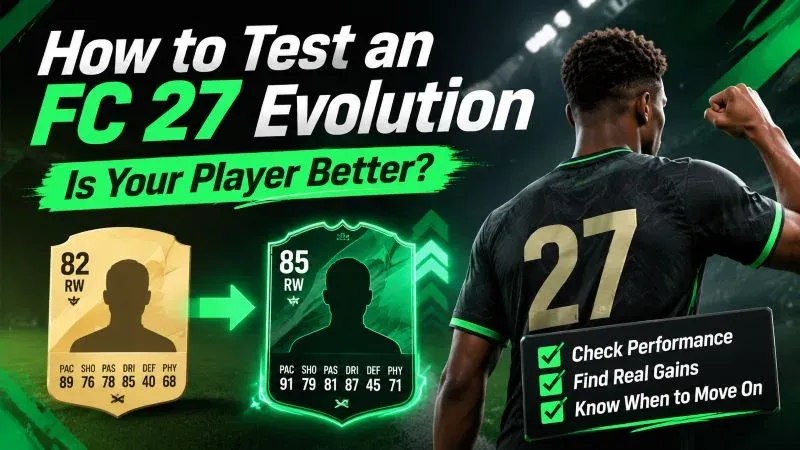
Before locking in an Evolution, compare the previewed final card with realistic market replacements in the same position and price range. OVR alone is a weak judge. A lower-rated evolved card can beat a market option if it carries the right PlayStyles, weak foot, skill moves, and chemistry fit for your tactic.
This is a hypothetical comparison, not a real in-game player test. Imagine you are upgrading your right midfield spot with an eligible RM. An active Evolution tweaks his profile to fit your possession style, while a similarly rated wide midfielder on the market brings different strengths.
| Comparison | Hypothetical Evolved RM | Hypothetical Market RM |
|---|---|---|
| Key attributes | Better dribbling and short passing | Higher sprint speed |
| PlayStyles | Gains a useful possession-focused trait | Lacks the trait your tactic needs |
| Chemistry | Fits your existing league/nation links | Requires squad adjustments |
| Trade status | Untradeable while the Evolution is applied | Tradeable |
| Commitment | No entry fee, but requires objective completion | Requires direct coin purchase |
The market card may look stronger on a raw stat sheet, but the Evo can win if its package fits your specific system. Conversely, if the market card checks every tactical box without the time sink, buying makes more sense. Since Transfer Market prices can change, compare the options using current prices rather than relying on an old estimate.
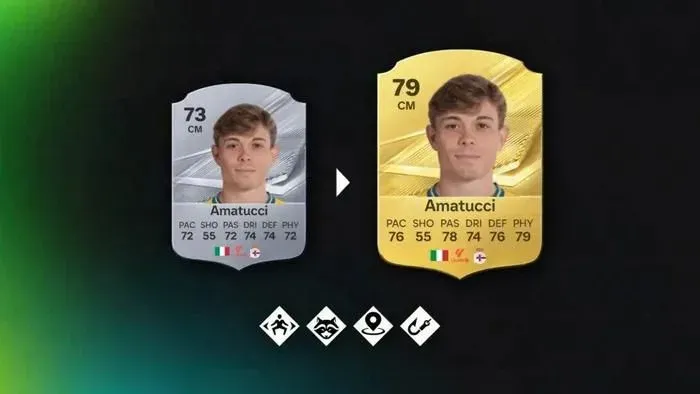
Does Your Squad Need an Upgrade or a Replacement?
A common trap is chasing an upgrade for its own sake. Start by naming the actual problem. Do you need a faster wide creator? A more reliable defensive midfielder? Or just extra bench depth for cup games?
For example, if your current starting RM already creates chances reliably, but you only want him to look a little different, an Evolution or market purchase may only be a side-grade. If your starting midfielder consistently gets overrun in transition, the goal is replacement, not a small cosmetic bump.
This distinction matters because both Evolutions and market cards cost resources. A bench upgrade is not automatically bad, but it should sit far lower in priority than fixing a clear starting XI weakness. Sometimes the best answer is to keep your coins and time, and wait for a better campaign reward or cheaper market window.
Check the Cost Beyond the Evolution Price
The headline cost — whether an Evolution is free or requires Coins or FC Points — is only the start.
First, consider the player you submit. If the base card is tradeable, its current market value still matters. Under EA's standard Evolution rules, the card becomes untradeable while the Evolution is applied. However, if it was originally tradeable, removing all applied Evolutions restores its tradeable status. Keep in mind that removing an Evolution is final, and you should not assume that any paid entry cost can be recovered.
This means the real trade-off is not always permanent loss of the card's market value. It is the temporary loss of trading flexibility, the risk of removing upgrades you may want to keep, and the time or currency committed to the Evolution.
Then factor in time. Even free Evolutions demand objective completion, matches, and focus. You also give up other uses for that player, such as using it as SBC fodder or saving it for another currently available Evolution.
The full cost formula has four parts:
- Entry cost: Any Coins or FC Points required to access the Evolution, compared with the cost of a suitable market alternative.
- Base player value: The market value tied up while an originally tradeable card remains in its evolved state.
- Time cost: Matches and objectives required to unlock the upgrade.
- Opportunity cost: Other squad improvements you could fund instead.
When Evolution Chains Change the Decision
FC 27’s Chain Preview lets you see whether a player, after one Evolution, still qualifies for currently available follow-up paths. Eligibility can still depend on the requirements of each individual Evolution, so check the final preview before committing. This is useful for long-term planning, but it is not a crystal ball. It cannot show eligibility for Evolutions EA has not yet released.
The decision here becomes a simple tradeoff: take a strong immediate upgrade now, or pick a milder path that keeps the door open to a second active Evolution that solves your squad problem even better. This only moves the needle when the follow-up chain is live and genuinely useful for your plan.
Three Decisions: Evolve, Buy, or Wait
These illustrative cases show how the framework lands on a clear outcome.
Case 1: Free Evolution vs cheap market replacement
You own an eligible wide player for a free Evolution. The finished card gains a PlayStyle your possession tactic needs and directly fills a gap in your starting XI. A similar market option exists, but it costs a meaningful chunk of coins and does not come with that same trait.
Verdict: Evolve wins. The time cost is justified because you fix a real weakness without spending coins.
Case 2: Strong immediate Evo vs a better active chain
One Pathway branch gives your CDM an instant defensive PlayStyle+, while the other keeps him eligible for a second active Evolution that would turn him into a much more balanced defensive anchor. Your squad’s biggest hole is defensive stability in transition.
Verdict: Choose the longer Evolution path. The smaller immediate boost is worth it for the stronger final result.
Case 3: Paid Evolution vs tradeable market player
A paid Evolution turns a CAM you own into a higher-rated untradeable option. A tradeable CAM on the market costs a similar amount, boasts stronger key passing stats, already has the PlayStyle your build demands, and requires no extra objective grinding. If your squad shifts later, you can also sell the market player to recover coins. The evolved card brings no unique trait that makes it irreplaceable.
Verdict: Buy wins. You get a better tactical fit, skip the grind, and keep your market flexibility.
Quick Decision Reference Table
| Situation | Better choice |
|---|---|
| Evo adds a unique PlayStyle your squad needs | Evolve |
| Market player offers better overall fit for similar cost | Buy |
| Current starter is already good enough | Wait |
| A currently available chain solves a bigger squad weakness | Consider the longer chain |
| You may need to sell or replace the player later | Buy a tradeable alternative |

Conclusion
Evolutions are excellent when they turn a player you already own into a uniquely tailored solution for a specific squad gap. They are weaker when the same coins and time buy a better, flexible, tradeable option on the market.
The best choice is not always “get the higher OVR.” It is whichever option solves your real squad problem for the lowest total cost — coins, player value, time, and lost flexibility included. And sometimes, the smartest play is simply to wait.