You’re a few thousand points short on a Streamlined SBC. A tradeable TOTW is sitting in your club. One tap and the bar clears. Feels like house money. Then you price it and realize the special card sells for far more than a gold card at the same rating—and the extra Item Score it delivers is nowhere near big enough to justify the gap. The SBC gets finished. The coins don’t. That’s the special-card fodder trap in FC 27, and it’s quietly draining coin balances across Ultimate Team.
The Score Is Real. The Premium Is the Problem.
EA’s launch notes confirm Item Score is built from OVR, Rarity, and Holographic status, and the bonuses stack—a Holographic TOTW receives both its rarity bonus and its foil bonus. So special cards do contribute more than a standard gold of the same rating. But “more score” is not the same as “good value.” A gold 84 sits at 830 Item Score, a gold 85 jumps to 2,100, and a gold 86 hits 4,100—the scoring curve is far steeper than most players assume.
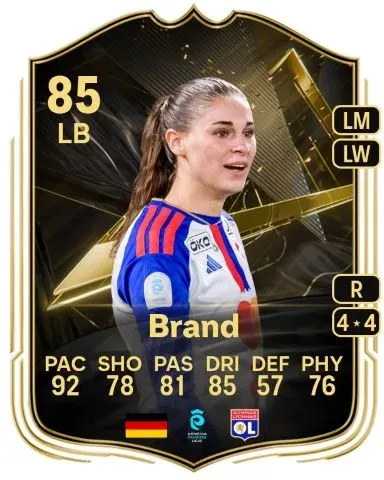
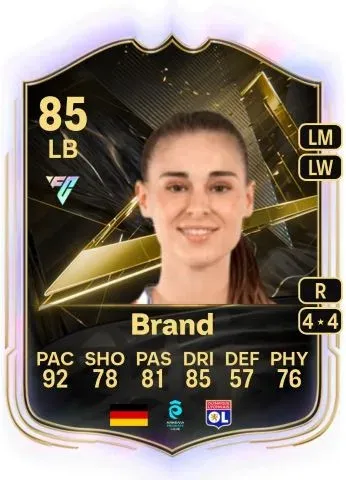
Jule Brand’s TOTW 9 card is the cleanest test case. FUT.GG lists her 85 TOTW at 2,625 Item Score—roughly 525 more than a standard gold 85. Her base gold is 84 OVR, not 85, and its score is 830, not 2,100. That distinction matters. If you compare her 84 gold to her 85 TOTW, the gap looks huge. But the fair comparison is the 85 TOTW against a same-rating gold 85 you could buy instead. Against that benchmark, the rarity premium buys about 525 extra points. The real question is what those 525 points cost you in forfeited sale value.
Run the Replacement-Cost Number, Not the Score Number
Here’s the only formula that matters:
Coin advantage of selling = sale proceeds after the 5% tax − cost of gold fodder that covers the same SBC gap.
For illustration, assume your platform’s current market price for Brand’s TOTW is 28,000 coins. Prices can vary significantly by platform and timing, so check the Transfer Market before selling. After the 5% tax, selling returns about 26,600 coins. If the SBC still needs 2,000 points, a single gold 85 covers 2,100 for around 1,100 coins (assuming no eligibility restriction blocks the gold replacement). Finish the SBC for 1,100 and keep roughly 25,500. Submit the TOTW instead and you “save” that 1,100—but forfeit the 26,600. The one-tap convenience costs you roughly 25,000 coins in this scenario.
That gap is common when a tradeable special carries a meaningful market premium over same-rating golds. And it’s not just a player-side calculation: EA doesn’t use the term “replacement cost”—but its November Developer Notes say the studio factors the cumulative Transfer Market cost of obtaining the items needed to accumulate the required Item Score into how it tunes SBC requirements. That’s the same variable, viewed from the player’s side.
Check What the Bar Actually Still Needs
Oversubmission is the second leak. EA Help confirms a warning fires when selected items “greatly exceed” the required Item Score—and that the warning does not make the excess or the card refundable. If the bar needs 1,500 points and you submit a 2,625-score TOTW, you overshoot by 1,125 points while sacrificing the entire market value of the card. EA states plainly that submitted items are permanently removed from your Club. If a partly completed SBC expires, you might receive a reduced untradeable reward based on your submitted Item Score—but the cards themselves never come back. A mix of cheaper golds gets you close to 1,500 with less overshoot and far less coin value locked into an irreversible submission. The warning is a label on a permanent decision, not a safety net.
Holographic: The Premium Shifts Form, Not Disappears
A Holographic special carries two stacked bonuses, so it scores more than a plain TOTW—EA’s own example is the Holographic TOTW receiving both bonuses at once. That makes it a bigger score contributor. It does not automatically make it better fodder. Selling a Holographic captures the rarity premium and the foil premium in coins. Submitting it converts those same premiums into Item Score instead. The premiums don’t vanish—they change shape. Converting coins into score only makes sense if the extra score is worth more to you than the coins you could recover. In most live markets, it isn’t.
When Submitting a Special Actually Makes Sense
The clearest candidates are untradeable duplicates with no realistic use elsewhere. They carry no direct market opportunity cost, which makes them far easier to justify as fodder. A close second is a special card whose market premium has collapsed near same-rating gold prices—late-cycle supply dumps can do this, and at that point the rarity bonus is basically free score.
Beyond those two, exceptions exist but require verification. An SBC may impose a special-card eligibility rule that golds can’t satisfy. The cheap eligible gold market may be dried up on your platform. A special may still hold lineup or Evolution value. None of those are defaults—they’re conditions you confirm with a price check and an eligibility read.
For everything else—tradeable TOTW, tradeable Holographic, a special with lineup value—run the replacement-cost number first. If its after-tax sale value exceeds the cost of golds that cover the same gap, sell it, buy the fodder, and keep the difference. The SBC doesn’t care where the points came from. Your coin balance will.