You have two eligible cards and one Evolution slot. Both clear the entry requirements. Both look like upgrades on paper. Six matches later, one has wasted several boosts because its key stats were already at their ceilings, while the other has quietly lost eligibility for the next Evo you actually wanted. FC 27 gives you better planning tools than FC 26 ever did, but the system still won’t stop you from making the wrong call. The fix isn’t another explanation of what Pathways and Chain Preview are. It’s a filter for which card deserves the slot at all.
Start With the Finish Line, Not the First Upgrade
The most common FC 27 Evo mistake is judging a card by the +5 it gets right now. Stop doing that. Look at the final card the Evolution is actually selling, then ask one question: does this finished version solve a role my squad is short on?
If the answer is “it’s an 83 that overlaps with three untradeable 83s I already have,” the Evo is clutter, not an upgrade. The slot is worth more than the rating bump.
This is also why you shouldn’t automatically chase the highest-rated eligible card. A higher starting OVR often means less headroom under the Evolution’s own stat limits, which translates directly into wasted boosts. A lower-rated card with clean distribution can gain more effective attributes than a shinier card that’s already close to the ceiling.
Check Headroom Before You Fall in Love
FC 27 Evolutions don’t add flat numbers to everything. They add numbers up to a cap, and anything already at or above that cap stays frozen. The formula is effectively max(base, min(base + boost, cap))—if a stat is already at or above its ceiling, it receives no additional boost.
Flank Identity is a useful example, but the lesson is easy to misread. Its 85 Pace requirement is an entry gate, not the same thing as the Sprint Speed or Acceleration ceilings inside each level’s upgrade. A card can clear the entry gate and still waste part of a specific boost if its Sprint Speed or Acceleration is already sitting at that level’s cap. The mistake isn’t “pick a lower-Pace card.” The mistake is not checking the detailed attributes against each level’s limits before you commit.
The rule is simple: open the Evo’s per-level breakdown, compare the card’s key attributes to the listed ceilings, and if two or three of its most important stats are already at or near those caps, seriously consider a different card. High starting stats feel good in the club menu. They feel terrible when the Evo’s biggest boosts land on a number that doesn’t move.
Chain Preview Is a Filter, Not a Guarantee
Chain Preview is the best addition to Evolutions in years. It shows which currently available Evolutions a card will still qualify for after you finish the one you’re previewing. That kills the FC 26 nightmare of finishing an Evo and only then discovering the card is ineligible for the next one—a failure mode that used to happen silently, with no in-game warning, after a stat quietly crossed a threshold.
But you need to understand the boundary. Chain Preview does not show future, unreleased Evolutions. It only reads the live pool right now. And eligibility is not just about one stat. An Evo’s requirements can include OVR caps, position, PlayStyle count, league, and attribute thresholds all at once. If the completed pathway leaves the player outside any of the follow-up Evo’s entry requirements, you may lose eligibility. That’s a different problem from the follow-up’s own boosts being capped.
So use it as a go/no-go check:
- If the chain looks clean, commit.
- If a follow-up exists but your chosen pathway leaves the player outside its entry requirements, pick the other branch or a different base card.
- If there is no meaningful follow-up in the live pool, don’t automatically skip. Judge the Evo on its standalone value. If the finished card fills a real gap in your squad, it can still be worth completing. If it offers neither immediate value nor a useful route forward, save the slot.
One filter. Three seconds. It saves you an hour of regret.
When to Stop (and When to Never Start)
Not every Evolution is worth finishing, and some aren’t worth starting. Two stop signs matter more than the rest.
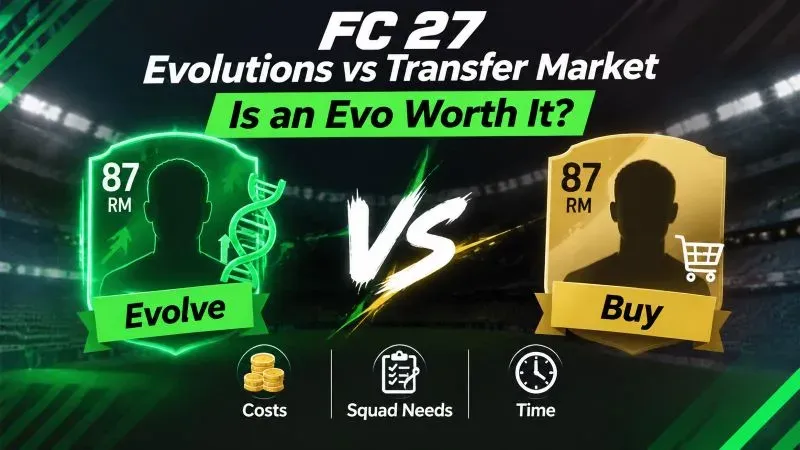
Stop sign one: the card already has a cheap market twin. If a cheap gold card does the same job as the Evo’s final product, the Evo wasn’t a win—it was a detour. Evos are at their best when they fill a position where the market is thin or overpriced, not where you can buy a comparable player for less than the coins and effort required to complete the challenges.
Stop sign two: the PlayStyle foundation is bad. For cards that go through the PlayStyles Lab, eligible items now arrive with some PlayStyles already pre-applied, and you only fine-tune a portion of the remaining slots. A useful pre-applied combination can make a card more attractive. But PlayStyles should support the role, not outweigh major weaknesses in its core attributes. You’re not rescuing a blank card anymore. You’re building on what’s already there.
The Pre-Commit Check
Before any Evo goes in, run this quick check:
- Final role: Does the finished card fill a position my squad actually needs?
- Headroom: Are its key stats already at or past the Evo’s per-level ceilings? If yes, seriously consider another card.
- Chain: Open Chain Preview. Does a follow-up exist, and will my chosen pathway keep the player within its entry requirements?
- Foundation: Does the card already have usable PlayStyles, or am I polishing a card with nothing underneath?
- Real cost: Could I buy a comparable card for fewer coins and less effort than this Evo requires?
If the card has a clear role, gains meaningful attributes, and remains worth using after the upgrade, commit. If the improvements are mostly wasted, or the finished card still has no place in your squad, walk away. The Evolutions that hurt aren’t the ones you skip. They’re the ones you finish and never use.