You look up and all four attackers are crowded into the same central area. The opponent’s center-backs are not even sweating. They sit compact, waiting for you to force a pass into traffic.
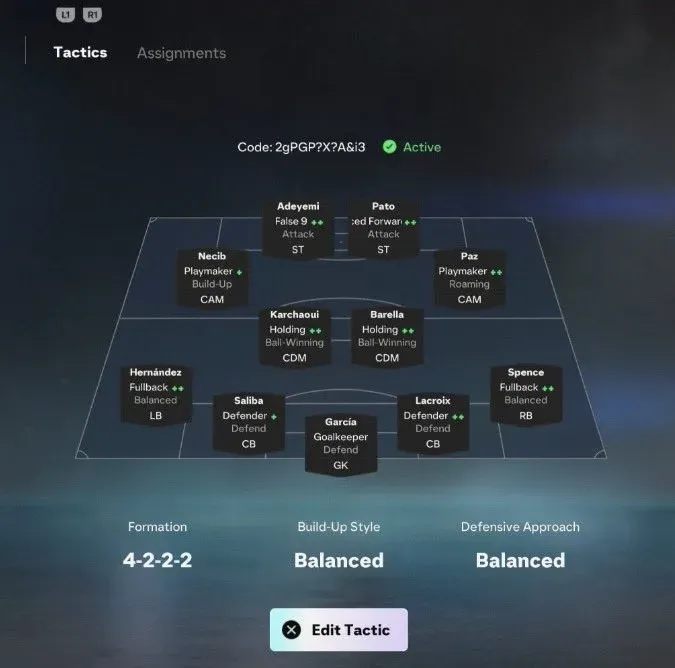
That is the reality of the 4-2-2-2 Box in FC 27. Two strikers, two CAMs, zero wingers. Karchaoui and Barella screen the back four. But against a low block, the wide channels become ghost towns. If nobody occupies them, your attack dies.
This is not a formation problem. It is a width problem. The code 2gPGP?X?A&i3 is a useful case study, not a magic button. It shows how to create width without a traditional winger.
Where Your Width Actually Comes From
Most players think width comes from pace out wide. In this setup, that is wrong. Your width comes from three different jobs, and you have to keep them separate.
Fullbacks Provide the Width
Hernández and Spence are on Fullback / Balanced. That role lets them support attacks while keeping more defensive responsibility than an aggressive attacking fullback. When Karchaoui has the ball and the central lane to Necib is jammed, Hernández is a safe release pass on the left. When Barella has it, Spence offers the same on the right. That gives you a wide passing option on either side without assigning either fullback an aggressive attacking role. But their forward movement is not guaranteed on every possession. You still have to trigger the overlap manually.
The Roaming CAM Creates Supporting Angles
Necib on Playmaker / Build-Up gives you a more central option for linking passes and organizing the attack. Paz on Playmaker / Roaming has more freedom to leave his starting position. When Necib is marked, Paz can drift into the right half-space. That gives Barella a shorter passing angle and can create room for Adeyemi and Pato. Paz will not always drag a defender with him. Read the block. Use his movement as an option, not a guarantee.
The False 9 Creates Central Space, Not Width
Adeyemi on False 9 is not your width source. He drops deep, connects play, and tries to pull a center-back out of line. When Adeyemi drops toward Barella, watch the center-back. If he follows, Pato on Advanced Forward can attack the space behind. Adeyemi creates central space. Hernández and Spence create width. Keep those jobs separate.
The Sequence: How to Unclog the Middle
Do not freestyle this. Follow the movement and read how the opponent reacts.
Start with Karchaoui or Barella in possession. If the central lanes to Necib and Paz are blocked, use the nearest fullback as a release option. Hernández can provide an outlet on the left. Spence offers the same on the right.
If the opponent shifts toward the ball, recycle through your CDMs and look to switch play to the opposite side. Paz’s Roaming role can give you another passing angle in the right half-space, while Necib remains a more central option. Use Adeyemi’s movement toward the ball to connect the attack. If a center-back follows him out of position, look for Pato’s run into the space behind.
You are not trying to beat a fullback one-on-one every time. You are trying to move the defensive block, create a new passing angle, and open a central route for Pato.
The Golden Rule: One Goes, One Stays
The biggest mistake with a narrow setup is sending both fullbacks forward at the same time. That can leave you exposed to a 3v2 counterattack, especially if Karchaoui and Barella are caught ahead of the ball.
This is a manual rule, not an automatic mechanic. If you send Hernández forward on the left, keep Spence deeper on the opposite side. That leaves a back three—Spence, Saliba, and Lacroix—behind the ball, giving you better protection against a turnover. Do not assume Hernández will automatically sprint back into position when possession changes. You have to manually pull him back or make sure Karchaoui is available to cover the space behind him. Avoid committing both fullbacks unless you are deliberately taking greater risks.
Final Verdict
A narrow 4-2-2-2 is not a death sentence. It is a puzzle. Your attacking width comes from Hernández and Spence’s positioning, Paz’s supporting movement, and Adeyemi’s timing to create space for Pato.
The code 2gPGP?X?A&i3 provides a balanced starting point, not a guaranteed solution. You still have to read the block, trigger the overlap, and protect the back door.
For deeper role mechanics, check our FC 27 Player Roles & Formations: What's Changed? guide. If you keep leaking goals when your fullbacks push, our FC 27 Manual Defending Tips will help clean up the counter.