The pattern is familiar: your opponent’s CAM finds pockets between your midfield and defense, two strikers stretch your back line with different runs, and wingbacks push forward to create overloads out wide. Many players react by chasing every runner, which quickly breaks their defensive shape and opens larger gaps. Instead of following the ball, focus on disrupting the connections between the CAM, the two strikers, and the attacking wingbacks.
Why 5-2-1-2 creates defensive trouble
The two strikers can stretch the defensive line with different runs, while the CAM looks for space between midfield and defense. Attacking wingbacks add width and force your defenders to cover more ground. This setup is not automatically broken; it only becomes dangerous when the CAM receives time on the ball and wingbacks commit high up the pitch. If you want to understand how this formation creates its attacking structure, see our guide to how the 5-2-1-2 setup is built.
The practical defensive workflow
Block the CAM before marking strikers
Your first priority is cutting the central supply line.If the CAM has not yet received the pass, use a central midfielder to shadow his passing lanes instead of sending a center back to chase him. If the CAM already controls the ball, apply light pressure with a nearby midfielder while keeping your back line organized. If the CAM drops deeper into midfield, track his movement without following him so far that you leave a gap in front of your defense. Keep another midfielder positioned to protect the space ahead of your back line.
Force the ball wide, then defend the delivery
Let the opponent move the ball toward the flanks. Keep your center backs deep and compact. Use your wide players to pressure the ball carrier, slow down crosses, and block cutback lanes into the box. The goal is not to stop every wide touch, but to prevent simple, high-risk passes into dangerous areas.
Keep your back line stable against two strikers
Read the run type before committing.If a striker drops short to receive, let your midfield step in to challenge. If a striker makes a run in behind, switch to the defender best positioned to cover the space behind your line. When both strikers move in different directions, avoid pulling both center backs out of position. Keep one center back covering the central channel while the other deals with the immediate threat, maintaining protection against a second run behind the defense.For more help with player switching and defensive positioning, check out our guide to manual defending decisions in Champs.

Exploit space behind attacking wingbacks
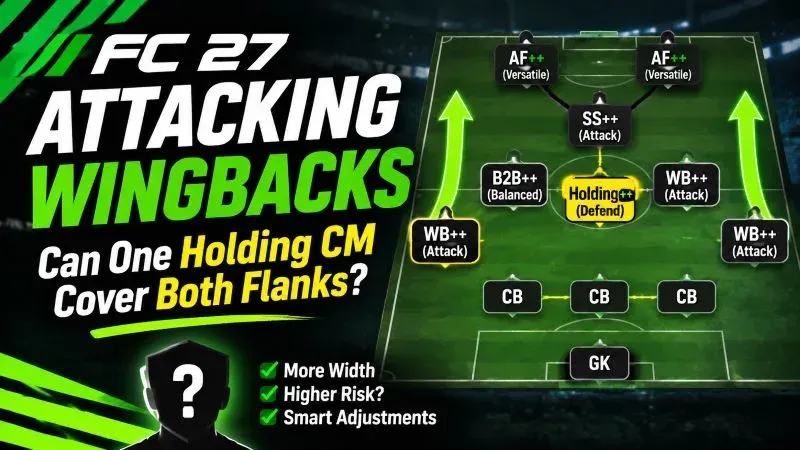
This is one of your best counterattack opportunities, but it depends on reading the opponent’s defensive shape quickly. Understanding how attacking wingbacks create space can also help you recognize when the opponent leaves a flank exposed.
- Identify the exposed flank: Check which wingback has pushed forward. Watch both sides — sometimes both wingbacks advance at once. If the opposing back three have shifted toward that flank, avoid forcing a pass into the crowded area. Look for a switch of play or recycle possession instead.
- Switch play before the defensive block recovers: Win the ball in safer zones, such as midfield or wide areas, instead of risky tackles inside your own box.
- Attack the gap with purpose: Use a wide player or overlapping runner to attack the exposed space before the wingback recovers. If your winger receives the ball with room to advance, carry it forward to draw out the nearest center back before looking for an inside pass or a cutback. If the opposing center back shifts toward the touchline, look for a pass inside to exploit the space he leaves behind. If the back three stay compact, keep the ball wide and force them to defend a larger area. If the defensive block has already shifted across, switch play again or recycle possession rather than forcing a pass into traffic.
Which Formation Should You Try Against 5-2-1-2?
No single formation is a guaranteed counter. Your choice depends on your style of play.
- 4-3-3: A good starting point if you want three midfielders to contest central areas while wide forwards stretch the back five and target space behind advanced wingbacks.
- 4-2-3-1: Pick this for extra midfield protection. The double pivot helps limit the CAM’s time and keeps your defense more stable.
These are tactical frameworks, not proven win-rate solutions. Player roles and custom instructions will change how well they perform in matches.
Common defending mistakes to avoid
- Pulling center backs out too early: Stepping out with a center back can leave space for the second striker to attack. Use a midfielder to challenge whenever possible and keep your defensive shape intact.
- Chasing the CAM with your center backs: This collapses your central block and opens through balls for the strikers. Keep center backs anchored to the back line.
- Ignoring the far-side wingback: Focusing only on the ball carrier lets the opposite wingback arrive unmarked in the box. Scan both flanks before pressing.
- Forcing counterattacks through the middle: Rushing straight down the center often plays into the 5-2-1-2’s three-center-back structure. Look for the space behind an advanced wingback before forcing a central pass.

Quick match checklist
- Close the CAM’s passing lanes.
- Keep center backs in position.
- Track both wingbacks before committing to a press.
- Protect the space behind your back line.
- Attack open flanks after winning the ball.
Defending against 5-2-1-2 is about controlling space, not chasing players. Disrupt the connection between the CAM and strikers, keep your back line organized, and use exposed flanks to launch counterattacks.