Your midfield keeps getting bypassed. One pass through the center, and your center-backs are exposed. More CDMs, deeper lines, manual pressing—none of it sticks. The issue usually isn't effort. It's structure.
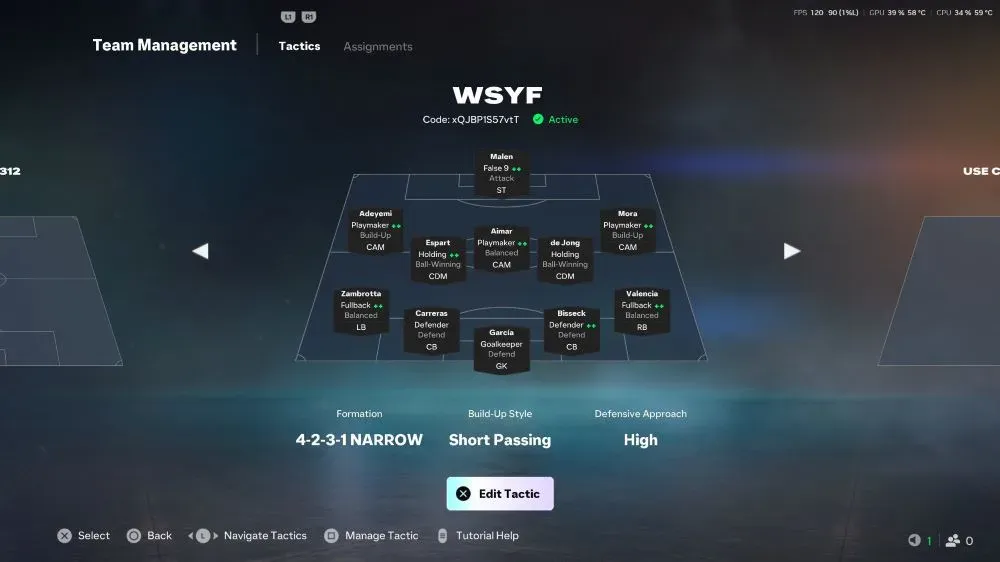
This FC 27 Short Passing setup is designed to address that by stacking the middle and giving your team more short passing options around the ball. It makes central progression harder for opponents—but leaves a clear trade-off out wide. Code: xQJBP1S57vtT. Formation: 4-2-3-1 Narrow. Build-Up: Short Passing. Defensive Approach: High.
(If you're new to the False 9 role itself, our FC 27 False 9 tactic code guide covers the basics. This article is about a different use of it—as the hub of a Short Passing possession system.)
High Is Not Aggressive
Most players hear “High” and assume constant stampede pressing. Under the FC IQ defensive approach system still referenced by FC 27 tactics guides, High covers line heights from 61–90 (default 70). The back line rarely tracks runs, pressure is minimal, and its Extra Stamina Drain setting is No. Aggressive sits at 91–100 (default 95), steps up rather than tracking, presses immediately after possession loss, and is the only approach with Extra Stamina Drain set to Yes.
That distinction is the foundation of this tactic. A High line keeps you compact without triggering Aggressive's immediate post-loss pressure or additional stamina drain. Your two Holders and three CAMs screen the center. The back four holds its shape. You're restricting passing lanes, not chasing the ball.
The False 9 Is a Two-Phase Connector
Malen on False 9 (Attack) drops between the lines, pulls a defender out of position, and becomes the first clean passing option when your Holders are under pressure. Without that drop, Short Passing dies in your own half.
Attack focus does more than drop. The False 9 still drops back from the opposition's defense, but also makes trailing runs into the box from deeper positions. Build-Up places more emphasis on dropping back and operating as a playmaker in the first phase. In this setup, Attack gives Malen a useful combination: he can connect the midfield during possession and still make forward runs to threaten the box.
The important part is what happens after he drops. If the center-back follows him, space can open for your CAMs to attack. If the defender holds, Malen has more room to receive and turn.
Three Creators, Two Holders
Aimar on Playmaker (Balanced) is the heartbeat. His Base Hero card carries 90 Short Passing, 89 Vision, and Tiki Taka+—built for receiving between the lines, playing the simple ball, and moving. He keeps the web connected.
Adeyemi and Mora on Playmaker (Build-Up) give the team more short passing options around the ball, helping maintain possession when central routes are crowded. Short Passing as a build-up style already asks players to come short and support the carrier; pairing that with Build-Up Playmakers on the flanks keeps the ball moving around Aimar rather than forcing every attack through him.
Espart and de Jong on Holding (Ball-Winning) are the insurance policy. Both stay home. When one steps to challenge, the other screens the center. This lets your full-backs push forward without leaving the center-backs completely naked.
When the Middle Gets Shut Down
Watch for two signs: your Holders are being pressed as soon as they receive, and Aimar is getting double-teamed between the lines. That's your cue to switch the point of attack. Circulate back to the center-backs, shift the ball to the opposite full-back, and force the opposition block to slide. Two or three quick switches create the half-yard your Playmakers need.
If the opponent is fully committed to a narrow central block, use a separate, more attacking tactical preset or bring on a direct wide attacker. Avoid pushing both full-backs forward at the same time—that leaves too much space behind a defense that already has no natural wide cover. The goal is to make the opponent pay for overcommitting centrally, not to abandon the structure.
The Real Weakness: Your Flanks Are Structurally Open
Three CAMs drift central. Zambrotta and Valencia on Fullback (Balanced) are your only width. When possession turns over, they're recovering from advanced positions, and the space behind them is the most direct route to your goal.
Manual defending can reduce the risk—use the nearest CDM to cover the wide channel and delay the carrier. But it cannot completely remove the structural weakness. Against teams that consistently overload the wings with fast wide players, switching to a wider, more balanced tactic is the smarter move.
When to Use It—And When to Bench It
Use it against opponents who want to play through the middle, or who sit in a low block and invite central breakdowns.
Bench it against direct, wide-counter teams with rapid wingers. The flanks are the price you pay for central control. Recognize that before kickoff, not after you're 2–0 down.

Bottom Line
This Short Passing system wins by making the middle a cul-de-sac. High keeps you compact without triggering Aggressive's immediate post-loss pressure or additional stamina drain. The False 9 connects your Holders to your creators—and still arrives late. Three Playmakers keep the ball moving. When the middle closes, switch the point of attack—but don't throw both full-backs forward. The flanks stay open by design. Use the code, know the trade-off, and keep a wider tactic on standby.